
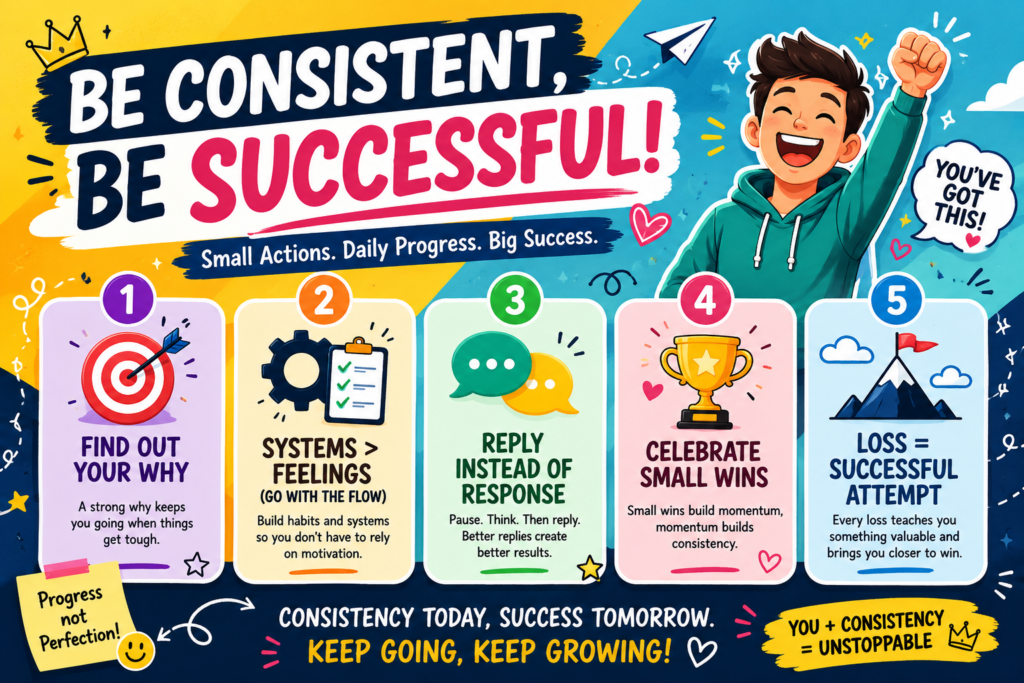
Everyone wants success, but very few people are willing to embrace the one thing that creates it consistently: consistency itself.
Success is rarely the result of a single breakthrough, a lucky opportunity, or a moment of inspiration. More often, it is the outcome of small actions repeated over days, weeks, months, and years. The challenge is not knowing what to do; the challenge is doing it consistently when motivation fades, obstacles appear, and progress seems invisible.
Here are five practical principles that can help anyone become more consistent and ultimately more successful.
1. Find Out Your “Why”
Before focusing on goals, focus on purpose.
When your “why” is strong enough, your commitment becomes stronger than your excuses. People who understand why they are pursuing something can continue even when the journey becomes difficult.
Ask yourself:
- Why is this goal important to me?
- What will happen if I achieve it?
- What will happen if I don’t?
A clear purpose creates direction. Direction creates focus. Focus creates consistency.
Whenever motivation disappears, revisit your “why.” It will remind you why you started in the first place.
2. Systems Are Greater Than Feelings
Many people wait until they feel motivated before taking action. Successful people do the opposite.
Feelings change every day. Some days you feel energetic and productive; other days you don’t. If your progress depends on your mood, your results will always be inconsistent.
Instead, build systems.
- Write every morning.
- Exercise at a fixed time.
- Read 10 pages daily.
- Review your goals weekly.
Systems remove the need for constant decision-making. They help you “go with the flow” of a structured routine rather than fighting internal battles every day.
Remember: Motivation gets you started, but systems keep you moving.
3. Reply Instead of React
Life constantly throws unexpected situations at us. A delayed project, a difficult colleague, a missed opportunity, or a failed plan can trigger emotional reactions.
Successful people learn to pause and respond thoughtfully rather than react emotionally.
Reaction is immediate and emotional.
Reply is intentional and strategic.
Before responding to a challenge, ask:
- What is the actual problem?
- What can I control?
- What is the best next step?
Your ability to manage your response often determines your success more than the situation itself.
4. Celebrate Small Wins
Many people only celebrate major achievements. As a result, they spend years feeling like they are not making progress.
Consistency becomes easier when you acknowledge small victories.
Celebrate:
- Completing a workout.
- Finishing a chapter.
- Delivering a task on time.
- Learning a new skill.
- Taking one step closer to your goal.
Small wins create momentum. Momentum builds confidence. Confidence strengthens consistency.
Success is not a single event; it is a collection of thousands of small victories.
5. Treat Every Loss as a Successful Attempt
Failure is often misunderstood.
A failed attempt does not mean you are unsuccessful. It means you have gained information, experience, and lessons that bring you closer to success.
Thomas Edison famously conducted thousands of experiments before creating a practical light bulb. Each failed experiment taught him what would not work.
Instead of saying:
“I failed.”
Try saying:
“I found another way that didn’t work.”
Every setback contains feedback.
Every loss is a successful attempt because it moves you one step closer to the right solution.
Final Thoughts
Consistency is not about being perfect. It is about showing up repeatedly, even when conditions are not ideal.
Find your why.
Trust your systems more than your feelings.
Reply instead of reacting.
Celebrate small wins.
View losses as successful attempts.
Do these five things consistently, and success will no longer be a matter of luck. It will become an inevitable result of your daily actions.
Remember: Great achievements are not built in a day. They are built every day.