
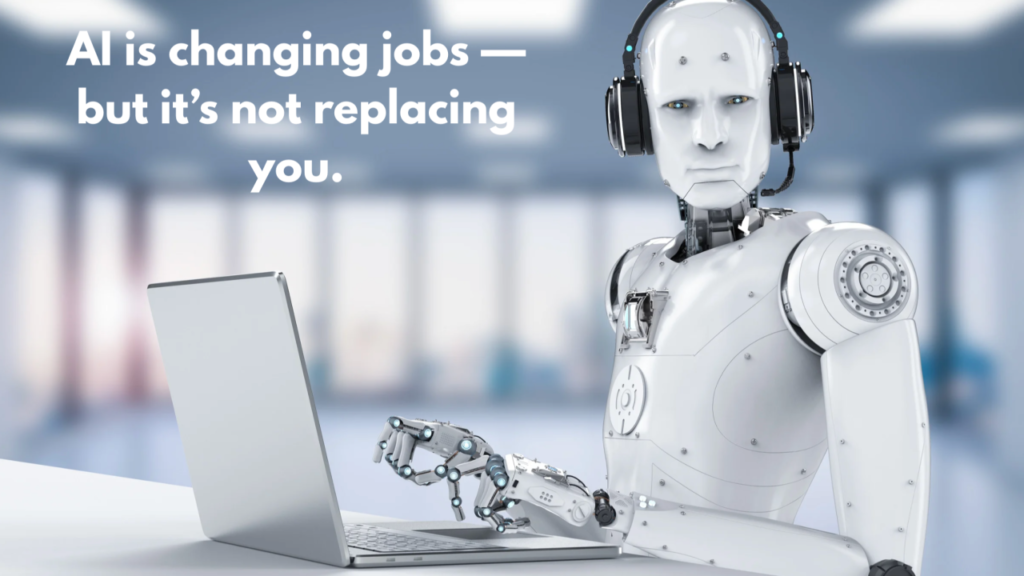
Stay in the AI Loop: How to Future-Proof Your Career in an AI-First World
AI is not coming for jobs someday.
It is already changing how jobs are performed.
A WordPress developer can now use AI to build a functional website in hours. An L1 support agent can be assisted—or replaced—by an AI agent that works 24/7. Social media teams can generate captions, images, content calendars and campaigns with a few prompts. Data entry can be automated through OCR and AI-powered document processing. Customer support bots can handle thousands of repetitive questions simultaneously.
This creates an uncomfortable question:
If AI can perform 60–80% of what I do today, what happens to my job tomorrow?
The answer is not necessarily to panic, change careers or become an AI engineer.
The answer is to stay in the AI loop.
The Challenge: AI Is Changing Tasks Before It Replaces Jobs
One of the biggest misconceptions about AI is that it will simply eliminate entire professions overnight.
In reality, the first thing AI changes is tasks.
A job is usually a collection of many activities.
For example, a social media manager may:
- Research topics
- Write captions
- Create images
- Schedule posts
- Respond to comments
- Analyze performance
- Develop campaigns
- Understand the audience
- Coordinate with sales and marketing
- Build the brand strategy
AI can increasingly handle several of these activities.
But understanding the audience, deciding what the brand should communicate, connecting content to business objectives and making strategic decisions still require significantly more context and judgment.
That means the real risk isn’t simply:
“AI will replace my job.”
The bigger risk is:
“Someone who knows how to use AI will replace someone who doesn’t.”
Five Jobs Already Facing Significant AI Pressure
Let’s look at five examples.
1. WordPress / Basic Website Developer
Building a basic website used to require significant technical effort.
Today, AI can assist with:
- Website structure
- HTML/CSS/JavaScript
- WordPress configuration
- Content generation
- Theme customization
- Plugin development
- Debugging
- SEO basics
- Landing pages
A client who previously needed a developer for a simple five-page website may increasingly be able to create a large part of it using AI-assisted tools.
The opportunity
Don’t remain a “WordPress website builder.”
Move toward:
Web Developer → Solution Engineer → Technical Consultant
Learn:
- APIs
- Integrations
- eCommerce
- Performance
- Security
- Cloud
- System architecture
- AI integrations
- Business requirements
The value moves from building pages to solving business problems.
2. L1 IT Support
L1 support contains many highly repetitive activities:
- Password resets
- Basic troubleshooting
- Ticket classification
- Account issues
- Standard configuration questions
- Knowledge-base searches
- Common software problems
AI agents can increasingly handle these interactions without human intervention.
The opportunity
Move toward:
L1 Support → L2/L3 → Automation → Cloud/SRE/Security
Learn:
- Automation
- PowerShell/Python
- Cloud platforms
- Networking
- Security
- Monitoring
- Incident management
- AI agent management
Instead of being the person who answers tickets, become the person who reduces the number of tickets.
That’s a completely different value proposition.
3. Social Media Content Management
AI can already help produce:
- Captions
- Hashtags
- Images
- Short videos
- Content calendars
- Post variations
- Social media replies
- Performance summaries
So if someone’s entire value is:
“I create and schedule 20 posts every month.”
that role is vulnerable.
The opportunity
Move from:
Content Creator → Content Strategist → Growth Marketer
Learn:
- Audience research
- Brand positioning
- Campaign strategy
- Analytics
- Conversion optimization
- Community building
- Customer psychology
- Lead generation
- AI-assisted content systems
Don’t just create content.
Understand why the content exists and what business outcome it should produce.
4. Data Entry and Processing
Data entry is one of the clearest examples of work that can be automated.
AI can increasingly:
- Read documents
- Extract information
- Classify data
- Validate fields
- Populate systems
- Detect anomalies
- Summarize information
- Move data between systems
If your primary value is manually transferring information from one system to another, automation will continue to put pressure on the role.
The opportunity
Move toward:
Data Entry → Data Operations → Automation → Data Analyst
Learn:
- Excel/advanced spreadsheets
- SQL
- APIs
- Workflow automation
- Data validation
- AI data extraction
- Business intelligence
- Data visualization
The goal is to move from handling data to making data useful.
5. Basic Customer Support
Customer support is another area where AI can handle a significant percentage of repetitive interactions.
For example:
“Where is my order?”
“How can I reset my password?”
“What is your return policy?”
“Can I change my delivery address?”
These questions don’t necessarily require a human every time.
The opportunity
Move toward:
Customer Support → Customer Success → Product Specialist → Customer Experience
Develop skills in:
- Complex problem solving
- Escalation management
- Customer relationship management
- Product expertise
- Customer retention
- Customer experience
- AI-assisted support operations
AI can answer a question.
But humans still have an important role when the customer has a complex problem, emotional situation, unusual requirement or high-value relationship.
So, How Do You Protect Your Career?
The answer isn’t:
“Learn AI.”
That’s too generic.
The real strategy is to change the type of value you provide.
Think about your career as a ladder:
Level 1 — Task Executor
“I do the task.”
Level 2 — AI-Assisted Executor
“I use AI to do the task faster.”
Level 3 — Problem Solver
“I understand the problem and determine how to solve it.”
Level 4 — System Builder
“I create a process or system that solves the problem repeatedly.”
Level 5 — Outcome Owner
“I am responsible for the business result.”
The higher you move, the harder it becomes to replace you with a simple AI tool.
Step 1: Understand What AI Can Already Do in Your Job
Start with your current job.
Don’t start with:
“Which AI course should I take?”
Start with:
“What parts of my job can AI already perform?”
Take your weekly activities and divide them into three categories:
A — AI can already do it
Automate or delegate it to AI.
B — AI can assist me
Use AI to make yourself significantly faster.
C — AI struggles with it
Invest more time in these activities.
For example, a project manager might discover:
AI can help with:
- Meeting summaries
- Status reports
- Risk identification
- Documentation
- User stories
- Research
- Communication drafts
But the PM still needs to:
- Resolve conflicts
- Negotiate priorities
- Manage stakeholders
- Make trade-offs
- Understand organizational politics
- Take accountability for outcomes
That tells you where to invest your development.
Step 2: Become an AI User Before Becoming an AI Expert
You don’t need to become a machine-learning engineer.
A salesperson doesn’t need to build an LLM.
A designer doesn’t need to train a model.
A project manager doesn’t need to understand transformer architecture.
But they should know:
How can AI make me better at my job?
Start using AI for your everyday work.
Then gradually move from:
Prompt → Workflow → Automation → AI Agent
That’s where the real productivity gains begin.
Step 3: Automate Your Own Repetitive Work
This is one of the most powerful career strategies.
Look at the work you repeatedly perform.
Ask:
“If I had to do this 1,000 times, how would I automate it?”
Maybe you:
- Prepare the same report every week
- Answer the same customer questions
- Create the same type of document
- Copy information between systems
- Analyze the same type of data
- Create similar social media content
- Perform repetitive testing
Don’t protect your task because you’re afraid automation will remove your value.
Automate it.
Then take ownership of the next level.
Your goal should be:
“I automated the work I used to do manually, and now I manage the system that performs it.”
That’s career growth.
Step 4: Move Up the Value Chain
This is perhaps the most important step.
Don’t stay at the same level while AI becomes better.
Move upward.
From execution to analysis
Don’t just produce the report.
Understand what the report means.
From analysis to decision-making
Don’t just identify the problem.
Recommend what should happen next.
From decision-making to ownership
Don’t just recommend the solution.
Own the result.
This transition changes your professional identity.
You stop being:
“the person who does X.”
And become:
“the person responsible for solving X.”
Step 5: Build Domain Expertise
AI has access to enormous amounts of general knowledge.
What it often lacks is your organization’s specific context.
That creates an opportunity.
Imagine two people:
Person A
Knows how to use AI.
Person B
Knows how to use AI + understands healthcare.
Person B can potentially solve much more valuable problems.
The same applies to:
- Banking
- Insurance
- eCommerce
- Manufacturing
- Real estate
- Education
- Healthcare
- Cybersecurity
- Government
- Supply chain
AI skills + domain expertise = powerful combination.
Step 6: Develop Human Skills AI Doesn’t Easily Replicate
The future isn’t purely technical.
Some of the most valuable skills will remain deeply human:
- Leadership
- Negotiation
- Empathy
- Communication
- Influence
- Decision-making
- Conflict resolution
- Creativity
- Critical thinking
- Relationship building
- Accountability
AI can give you ten possible solutions.
Someone still needs to decide:
Which one should we actually implement?
And more importantly:
Who will take responsibility if it fails?
That is where human value remains powerful.
Step 7: Learn to Work With AI as a Team Member
Stop thinking of AI only as a chatbot.
Think of it as a collection of digital teammates.
You might have:
- A research agent
- A writing assistant
- A coding assistant
- A data analyst
- A testing agent
- A customer support agent
- A documentation agent
- A reporting agent
Your role gradually becomes:
Human + AI → AI-powered workflow → AI-powered team
The people who learn to orchestrate these systems will have a significant advantage over people who only use AI occasionally.
The Biggest Mistake: Waiting Until Your Job Is Threatened
Many people will make the same mistake.
They will wait.
They will wait until:
- Their company introduces AI
- Their department starts reducing headcount
- Their tasks become automated
- Their productivity expectations increase
- Their manager asks them to use AI
By then, the transition may already be underway.
Instead:
Start before you are forced to start.
Use AI when you don’t need it.
Experiment when failure is inexpensive.
Build skills before they become mandatory.
Don’t Try to Beat AI at AI’s Game
This is another important mindset shift.
If AI can generate 100 social media captions in seconds, don’t try to become the person who writes captions faster.
If AI can build a basic website in minutes, don’t compete on how quickly you can build a basic website.
If AI can summarize a 50-page document in seconds, don’t compete on reading speed.
Instead, ask:
“What can I do with the output that AI cannot easily decide for me?”
That is where your value moves.
The New Career Formula
The old formula was often:
Skill + Experience = Career Value
The emerging formula is closer to:
Domain Expertise + AI Fluency + Human Skills + Ownership = Career Value
You don’t necessarily need to become an AI specialist.
You need to become an AI-enabled specialist in something valuable.
5 Tips to Stay in the AI Loop
If you remember nothing else from this article, remember these five.
1. Use AI Every Day
Don’t learn AI only through courses.
Use it in your real work.
The best AI learning happens when you solve actual problems.
2. Automate One Repetitive Task Every Month
Pick something boring.
Automate it.
Then pick another.
In one year, you could have twelve workflows that significantly increase your productivity.
3. Learn Your Industry Deeper
Don’t become another generic “AI person.”
Become:
AI + Healthcare
or
AI + Finance
or
AI + eCommerce
or
AI + Project Management
or whatever combination fits your career.
4. Move From Tasks to Outcomes
Don’t define yourself by what you produce.
Define yourself by the problem you solve.
Tasks can be automated.
Outcomes require ownership.
5. Stay Curious
AI will keep changing.
Today’s best tool may not be tomorrow’s best tool.
Today’s workflow may become obsolete.
So don’t build your career around one AI tool.
Build your career around the ability to learn, adapt and apply new technology quickly.
Final Thought
The question shouldn’t be:
“Will AI take my job?”
A better question is:
“If AI takes 50% of my current tasks, what valuable work will I do with the other 50%?”
That question changes everything.
Because the future probably won’t belong to people who avoid AI.
And it won’t necessarily belong only to people who build AI.
It will belong to people who know how to combine AI with their expertise, experience, judgment and human skills.
Don’t wait for AI to enter your industry.
Enter the AI loop yourself.
Learn it.
Use it.
Experiment with it.
Automate with it.
Build with it.
And most importantly—
Keep moving up the value chain.