
We often talk about growth as if it is a straight line.
Learn more.
Work harder.
Get promoted.
Build something.
Achieve the goal.
But real growth rarely looks like that.
There are setbacks. There are failures. There are unexpected changes, difficult people, missed opportunities, criticism, rejection and moments when you question whether you are moving forward at all.
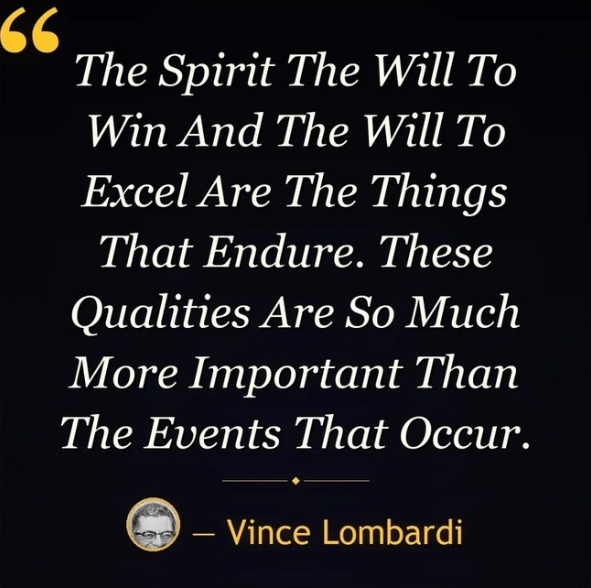
That is why this quote from Vince Lombardi carries an important lesson:
“The spirit, the will to win and the will to excel are the things that endure. These qualities are so much more important than the events that occur.”
When viewed from the perspective of growth, the message is simple:
You cannot control every event, but you can control how you respond to it.
Growth Is Tested During Difficult Times
It is easy to stay positive when everything is going according to plan.
The real test comes when:
- Your project fails.
- Someone rejects your idea.
- You don’t get the promotion you expected.
- Your business doesn’t perform as planned.
- Someone criticizes your work.
- Your plans suddenly change.
- You make a mistake.
- Someone else gets the opportunity you wanted.
These moments can either become a reason to stop or an opportunity to grow.
The event itself is only one part of the story.
Your response becomes the other part.
1. Focus on What You Can Control
One of the biggest reasons we lose positivity is spending too much energy on things outside our control.
You cannot control:
- What other people think.
- How someone behaves.
- Whether an opportunity comes.
- What happened yesterday.
- Every business or market condition.
- Someone else’s decision.
But you can control:
- Your preparation.
- Your attitude.
- Your effort.
- Your learning.
- Your communication.
- Your next action.
Instead of asking:
“Why is this happening to me?”
try asking:
“What can I do about it?”
That simple shift can change your perspective.
2. Don’t Let One Bad Event Define Your Journey
A bad day is not a bad career.
A failed project is not a failed career.
A rejection is not a rejection of your entire potential.
A mistake is not your identity.
Sometimes we take one negative event and allow it to define everything else.
Instead, look at the bigger picture.
Ask yourself:
“Is this a permanent situation, or is it just a difficult moment?”
Most of the time, it is a moment.
Keep moving.
3. Replace “Failure” With “Feedback”
Failure can feel final.
Feedback feels actionable.
Instead of:
“I failed.”
Try:
“Something didn’t work. What did it teach me?”
Every unsuccessful experience can provide information.
Maybe your preparation was insufficient.
Maybe your communication wasn’t clear.
Maybe the timing was wrong.
Maybe the strategy needs to change.
Maybe you need a new skill.
The objective isn’t to pretend failure doesn’t hurt.
The objective is to extract something valuable from it.
4. Stop Comparing Your Chapter 2 With Someone Else’s Chapter 20
Social media makes this particularly difficult.
You see someone’s:
- promotion
- new business
- success
- international opportunity
- achievement
- expensive purchase
But you rarely see the years of preparation behind it.
Growth is personal.
Someone may reach a milestone at 25.
Someone else may reach it at 35.
Another person may discover an entirely different path at 45.
There is no universal timeline for growth.
Compare yourself with who you were yesterday, not with someone else’s highlight reel.
5. Stay Curious
Positivity doesn’t mean pretending everything is good.
Sometimes things genuinely aren’t good.
A healthier response is curiosity.
Instead of:
“This is terrible.”
Ask:
“What is this situation trying to teach me?”
Curiosity creates space between the problem and your reaction.
It allows you to think.
And thinking creates better decisions.
6. Celebrate Small Progress
We often wait for major achievements before allowing ourselves to feel successful.
But growth happens through small improvements.
You learned something new.
You handled a difficult conversation better.
You communicated more clearly.
You solved a problem faster.
You became more disciplined.
You made a better decision than you would have made six months ago.
These are all signs of growth.
Don’t ignore small wins simply because you are still chasing a big one.
7. Surround Yourself With People Who Help You Grow
Your environment matters.
Spend time with people who:
- challenge your thinking
- encourage learning
- give constructive feedback
- celebrate your progress
- tell you the truth
- help you see possibilities
And be careful about environments where negativity becomes the default response to everything.
There is a difference between constructive criticism and constant negativity.
One helps you improve.
The other slowly changes how you see everything.
8. Keep Moving When Motivation Disappears
Motivation is useful.
But motivation is unreliable.
Some days you will feel energetic and excited.
Other days you won’t.
That is normal.
This is where discipline matters.
You don’t need to make huge progress every day.
Sometimes the win is simply:
Keep going.
Read one page.
Solve one problem.
Make one call.
Learn one concept.
Complete one task.
Take one step.
Small steps repeated consistently can take you much further than occasional bursts of motivation.
9. Don’t Confuse Positivity With Ignoring Reality
Being positive doesn’t mean saying:
“Everything is fine.”
when everything isn’t fine.
Real positivity is more practical.
It says:
“This is difficult, but I can still do something about it.”
It acknowledges the problem without surrendering to it.
You can be disappointed and still hopeful.
You can be frustrated and still focused.
You can fail and still continue.
You can have a bad day and still believe tomorrow can be better.
That’s resilience.
10. Keep Your “Why” Visible
When things become difficult, your original purpose can become unclear.
Go back to your WHY.
Why did you start?
Why are you learning?
Why are you building?
Why are you leading?
Why are you trying to improve?
Your WHY can become the anchor that keeps you moving when the journey becomes uncomfortable.
A Simple Growth Checklist
When something goes wrong, pause and ask yourself these five questions:
1. What happened?
Look at the facts.
2. What is within my control?
Separate influence from things you cannot change.
3. What can I learn?
Turn the experience into knowledge.
4. What can I do differently next time?
Convert learning into action.
5. What is my next step?
Don’t stay stuck analyzing forever.
Learn → Adjust → Act → Continue.
The Real Meaning of Growth
Growth isn’t always visible.
Sometimes growth is getting a promotion.
Sometimes it is building a successful company.
Sometimes it is learning a new technology.
But sometimes growth is much quieter.
It is staying calm during a difficult conversation.
It is accepting criticism without becoming defensive.
It is trying again after failure.
It is saying no when you previously couldn’t.
It is learning from someone younger than you.
It is admitting:
“I don’t know, but I can learn.”
These moments may not appear on your CV, but they shape who you become.
Key Takeaways
1. Control your response, not every event.
2. Don’t allow one bad experience to define your entire journey.
3. Turn failure into feedback.
4. Stop comparing your journey with someone else’s.
5. Stay curious when things go wrong.
6. Celebrate small improvements.
7. Choose an environment that encourages growth.
8. Build consistency instead of depending only on motivation.
9. Be realistic, not blindly positive.
10. Remember your WHY when the journey gets difficult.
Final Thought
We don’t always get to choose the events that happen to us.
But we get many opportunities to choose what we do next.
That is where growth begins.
Your circumstances may influence your journey.
Your response shapes it.
Your consistency transforms it.
And perhaps the most important lesson from Lombardi’s quote is this:
Don’t measure your growth only by the events you achieve. Measure it by the person you become while pursuing them.